How to Keep Inclusion Without Making Your Org a Target: Repair-Centered Leadership in Polarized Times
By April N. Baskin
I’ve been sitting with a truth that many leaders feel in their bones right now:
You can’t lead a mission-driven organization in 2026 with a 2019 playbook.
Inclusion work has become a flashpoint. Words are getting scanned for ideology. Board members are anxious. Staff are tired. And many leadership teams are making decisions from a place of public risk rather than internal integrity.
This is not a morality essay.
This is a survival-and-clarity piece for leaders who still want to protect target inclusion and diversity—and do it in a way that reduces backlash risk, strengthens trust, and keeps your people from collapsing into silence.
The moment we’re in: when inclusion becomes a flashpoint
This isn’t just politics. It’s operational risk.
When headlines, donors, or governing bodies start punishing anything labeled “DEI,” leaders often respond by tightening language, pausing initiatives, or quietly moving responsibilities into “HR” where they feel less visible.
Sometimes that’s prudent. Sometimes it’s panic.
Either way, the operational risk is real:
Recruiting and retention suffer when people don’t trust the culture.
Decision-making slows when leaders can’t name what matters.
Conflict grows when people have no shared repair process.
The hidden cost: silence, exit, and slow culture drift
When teams sense they might be punished for “saying the wrong thing,” they stop talking. When people stop talking, you lose early-warning signals. When you lose early warnings, harm doesn’t disappear—it just goes underground.
Underground harm becomes:
Turnover you can’t fully explain.
Meetings that feel polite and dead.
Public blow-ups that feel “sudden” (but never are).
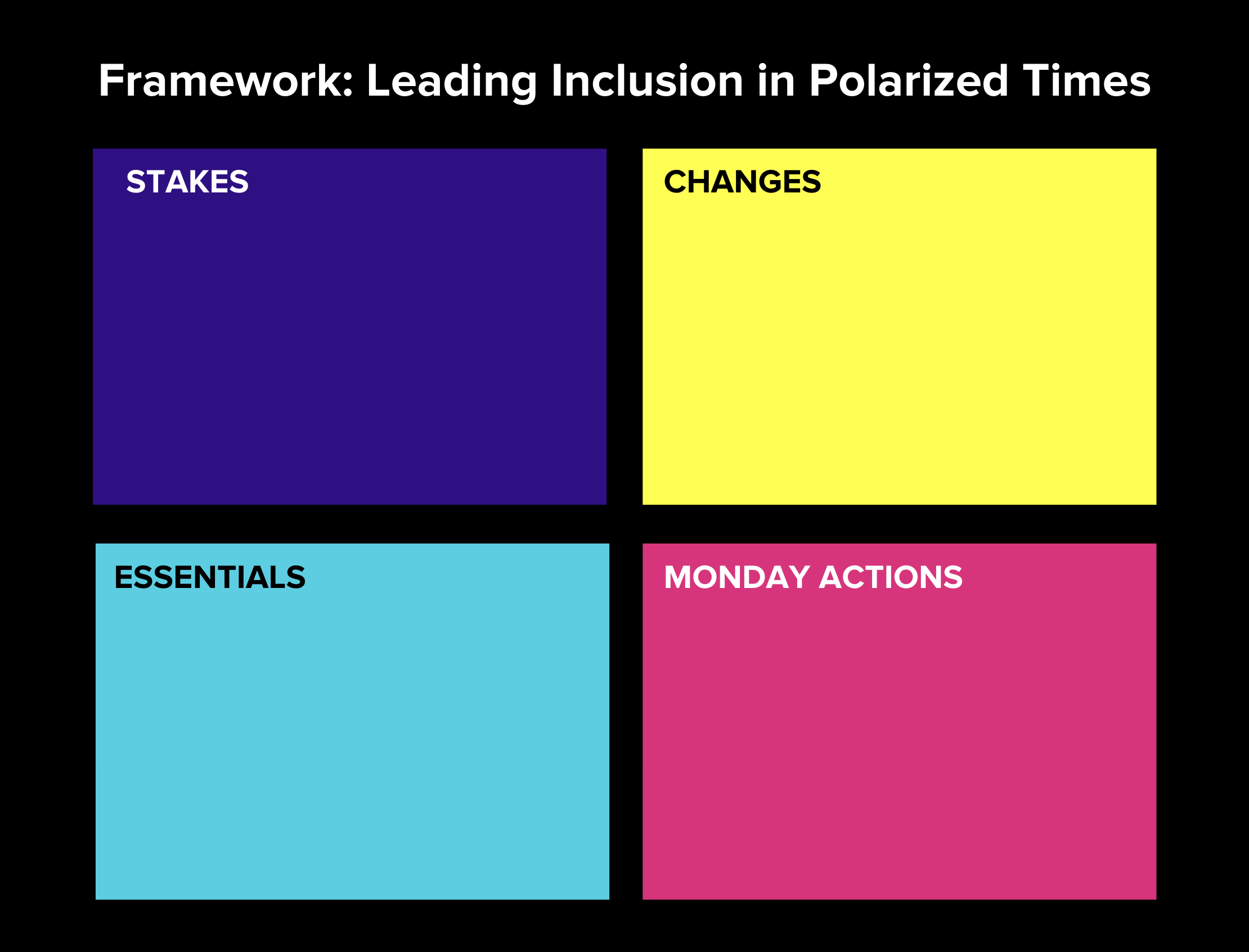
A simple one-page framework graphic showing the four sections: what’s at stake, what changed, what still must be done, and what to implement and operationalize or, said differently, “do Monday morning.”
What’s at stake (for leaders, teams, and missions)
Psychological safety is a performance system, not a perk
Psychological safety is often described as “people feeling comfortable.” That’s true, but incomplete.
In leadership terms, psychological safety is your ability to get accurate information—especially from people with less power, different identities, or dissenting views.
Without it, you don’t get truth. You get compliance theater.

A leadership team in a facilitated circle conversation with data tracking and a calm setting
Trust is your retention strategy
In polarized times, many organizations are trying to retain staff with benefits and flexibility (important). But people also leave when the relational climate becomes unsafe or incoherent—when values are stated but not practiced, when conflict is punished, when harm is minimized, when accountability is performative.
Trust is what keeps people from emotionally checking out.
Repair is how organizations can metabolize & transform harm
Here’s one of my core beliefs: DEI, at its best, is about repair—about humanizing all of us for our collective good and progress.
Repair means you can name impact, address it, learn, and continue working together without turning every rupture into a loyalty test or a shame spiral.
Organizations that can repair don’t become “perfect.” They become durable.
What changed (and why your old playbook may be failing)
Public narratives escalated; internal fear followed
In many sectors—nonprofits, education, philanthropy, and public institutions—the external climate has shifted from debate to crackdown. You may be watching national news and thinking, “If that can happen there, it can happen here.”
So leaders do what leaders do under threat: they simplify, they clamp down, they try to control the message.
But inclusion and diversity aren’t just “messages.” They’re daily practices.
Language is being weaponized—inside and outside your org
Words like equity, privilege, and even belonging can now trigger pre-loaded “culture-war” scripts—sometimes from external stakeholders, sometimes from staff who feel exhausted by polarized discourse.
This doesn’t mean you should abandon your commitments.
It means you need a clearer translation layer: language that is accurate, legally mindful, and operationally useful.
“Training” isn’t enough when the pressure is constant
A one-time workshop doesn’t change a culture under stress.
In polarized times, leadership teams need ongoing capacity in:
Cross-cultural communication for leadership teams under pressure.
Facilitating difficult conversations at work without escalation.
Repairing harm at work with clarity and dignity.
What still must be done (even if you stop calling it DEI)
Protect fair access and consistent standards
Even if you retire the acronym, you still have to answer practical questions:
Are hiring, pay, and promotion standards consistent and documented?
Do people have equal access to information, mentorship, and opportunity?
Do policies get applied evenly, or only when convenient?
This is not about optics. This is about operational integrity—and risk reduction.
Build cross-cultural communication capacity
Cross-cultural communication isn’t a “nice to have.” It’s a core leadership skill when your team includes different identities, histories, and thresholds for conflict.
It includes the ability to:
Ask curious questions without interrogation or defensiveness.
Distinguish intent from impact without erasing either.
Name power dynamics without turning people into villains.
Create a repair pathway that avoids shame spirals
Many organizations swing between two painful extremes:
Minimization: “It wasn’t that bad. Let’s move on.”
Punishment: “Someone must be publicly marked as the problem.”
Repair is the middle way: responsibility without humiliation, learning without abandonment.

An abstract image of a bridge formed from diverse stones symbolizing working across difference.
How to talk about inclusion and diversity without triggering “culture-war” scripts
A reframing that leaders can stand behind
If you’re trying to keep inclusion without becoming a target, ground your language in what most stakeholders actually want—whether they say it in justice terms or not:
A workplace where people are treated fairly and consistently.
Clear standards and transparent decision-making.
High trust, low drama, and real accountability.
You can say something like:
“Our commitment is to fair access, respectful collaboration, and consistent standards—so we can do excellent work without leaving people behind.”
What to say to your board, staff, and skeptics
To your board: “We are reducing reputational risk by focusing on measurable practices: consistent hiring standards, respectful conduct norms, and a clear process for addressing harm.”
To your staff: “We’re not abandoning inclusion. We are tightening our approach so it’s sustainable, clear, and less vulnerable to reactive narratives.”
To skeptics: “You don’t have to share every framework to participate. The standard is simple: we treat people with dignity, we address issues directly, and we hold consistent expectations.”
Phrases to avoid when people are already braced
If your environment is tense, avoid language that sounds like moral sorting or ideological certification. Not because your values are wrong—because your goal is to keep the room workable.
Consider reducing:
Broad labels that invite projection rather than clarity.
Absolutes that trigger defensiveness and debate.
Public call-outs when private repair is possible.
Repairing harm without creating shame spirals
The difference between accountability and humiliation
Accountability says: “This happened. It mattered. Here’s what we’re going to do now.”
Humiliation says: “Your belonging depends on your perfection.”
Humiliation breeds hiding. Hiding breeds repeated harm. Accountability—with dignity—creates learning.
A simple repair framework & script leaders can use
When a rupture happens, many leaders freeze because they don’t want to make it worse. Here is a repair-centered script that helps you move without theatrics:
Name the impact: “I hear that what happened landed as dismissive and created distrust.”
Locate responsibility: “Here’s what I can take responsibility for, and what I need to understand better.”
Ask for the needed change: “What would repair look like in practice—this week, not someday?”
Commit to a next step: “Here’s what we’re going to do, by when, and who will own it.”
This is how you interrupt shame spirals: you focus on impact, responsibility, and next actions—not character assassination.
When to facilitate, when to coach, when to use HR/legal
Not every conflict is a “courageous conversation.” Sometimes it’s a performance issue. Sometimes it’s discrimination. Sometimes it’s miscommunication amplified by stress.
Use this simple sorting:
Facilitation: when a group needs shared understanding, agreements, and forward motion.
Coaching: when a leader needs to regulate, clarify their stance, and practice language.
HR/legal: when there are credible allegations, protected-class concerns, or policy violations.
What to do Monday morning: a 45-minute leader reset
You don’t need a new mission statement. You need a steadier operating system.
Here is a Monday-morning sequence I use with leadership teams to create decision clarity fast.
Step 1: Name the reality without making enemies
In your next leadership meeting, try one clean sentence:
“We are leading in a polarized climate, and we need an approach to inclusion and diversity that is principled, practical, and harder to distort.”
Then pause. Let the room breathe.
Step 2: Stabilize your decision criteria (so you stop swinging)
Write 3 decision criteria you will use for any inclusion-related decision this quarter. For example:
Does it increase fair access and consistent standards?
Does it strengthen trust and psychological safety across differences?
Is it legally and operationally coherent for our context?
When leaders don’t have criteria, they have moods. Criteria reduce reactivity.
Step 3: Choose one conversation to facilitate this week
Pick one real tension that keeps leaking into side chats. Decide to address it directly, with a container. A container means:
A clear purpose and desired outcome.
Agreements for respectful communication.
A facilitator (internal or external) who can hold complexity.
Step 4: Install two micro-practices that build psychological safety across difference
Choose two practices you can maintain even during busy seasons:
Start meetings with “what’s important to name”: one minute each, no fixing.
Use a “two truths” norm: “My intent was X, and the impact was Y.” Both can be real.
Close with commitments: “What are we each taking responsibility for before next week?”
Step 5: Decide what you will stop doing (to reduce risk)
Risk reduction isn’t only about what you start. It’s also about what you stop.
Consider pausing:
Reactive all-staff emails written in the heat of fear.
Performative statements that outpace your actual capacity.
Unfacilitated “open forums” when the trust level is low.
You can be courageous and strategic.
When you need outside support (and what good support looks like)
Signs you need a facilitator for difficult conversations at work
Consider bringing in support when:
Your leadership team keeps circling the same conflict without resolution.
People are afraid to speak honestly in front of certain colleagues.
Repair attempts keep turning into defensiveness, shutdown, or blame.
What a repair-centered consulting engagement can include
In my work through Joyous Justice, support often includes a blend of:
Leadership decision clarity and language coaching for polarized contexts.
Facilitated sessions to rebuild trust and agreements across differences.
Trauma-informed conflict and repair pathways that avoid shame spirals.
Consistently customized, grounded, and built to account for real constraints and challenges.
An invitation, not a push
If you’re trying to evolve your strategy to meet this complex moment—so you can protect inclusion without making your organization a target—I’m here.
If that feels resonant, you’re warmly invited to explore working together through consulting, coaching, or facilitation.
A closing reflection for leaders holding the line
You don’t have to choose between courage and care
You can refuse “culture-war” scripts and refuse silence.
You can name harm without humiliating people.
You can build a culture that is steady enough to tell the truth—and strong enough to keep going.
That steadiness is not naïve. It’s leadership.