Multiracial Movement Building: What It Really Takes to Maintain Coalitions That Last
This isn’t easy to say, especially in spaces where we want liberation work to feel clean and inspiring.
Multiracial movement building is essential for the safety and well being of our communities, and for the future of a planet in crisis. It is also complex, intimate, and regularly destabilized by histories that never received repair. Enslavement. Genocide. Anti semitism across millennia. Forced displacement. Cultural erasure. The ongoing afterlives of all of it.
If your organization has tried to build multiracial multicultural coalitions and found yourselves stuck in conflict loops, exhaustion, or brittle “unity,” you are not alone. This work can be holy, and it can be hard on the nervous system.
What helps is not more ideology. What helps is more readiness.
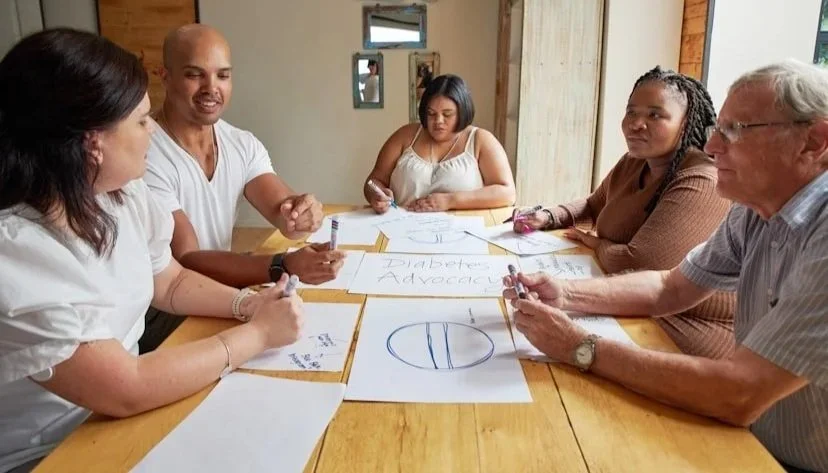
A diverse coalition in a collaboraitve meeting, conveying grounded collaboration across difference.
The part we skip: multiracial coalitions are essential, and they are also hard
Why “essential” does not mean “simple”
Many leadership teams have been taught to treat coalition building as a matter of shared values plus good intentions. That story collapses under pressure.
Effective multiracial movement building asks people to share power, risk reputation, and stay present through misunderstanding. It asks us to coordinate across different cultural norms about time, communication, leadership, conflict, and trust. It asks us to do it while we are already overworked, already under resourced, already being watched.
That is why “we all agree” is rarely enough to keep a coalition intact.
Unhealed history is not background noise, it is the weather
Historical harm is not simply something we study. It lives in bodies, families, institutions, and default settings. Even in the most values aligned spaces, oppression is baked into the broader society that formed us.
So the question is not whether harm shows up. The question is whether we are prepared to respond in a way that keeps relationship possible.
Reframe #1: It is not if harm happens, it is when
A coalition that can only function when everyone is regulated, resourced, and feeling generous is not a coalition, it is a fair weather friendship.
In sustained multiracial multicultural work, bias and misattunement will surface. Microaggressions. Macroaggressions. Careless language. Defensive body posture. Silence that lands like dismissal. “Small” moments that carry an old, familiar ache.
Predictable friction points in multiracial multicultural work
Stress and urgency: under deadline or public scrutiny, people revert to conditioned patterns.
Different conflict norms: directness versus indirectness, fast processing versus slow processing, debate as care versus debate as threat.
Unspoken power dynamics: funder proximity, credentials, board relationships, race, class, gender, and organizational seniority.
Identity pain colliding with strategy: what feels like “just tactics” to one group can feel like erasure to another.
Build a repair plan before you need it
Coalitions often create shared goals and messaging documents, yet skip the operational plan for rupture. A repair plan is not a sign of pessimism. It is a sign that you understand reality.
A practical repair plan includes:
Agreements for addressing impact: how harm is named, who is involved, and what timelines are realistic.
A containment pathway: where a conflict goes when it becomes too hot for a full group conversation.
A repair vocabulary: shared language for impact, intent, accountability, and next steps.
Resourcing: facilitation support, coaching, or community care that keeps people from handling everything alone.
Repair is a skill set. If your coalition has no shared skill set, every rupture becomes a referendum on belonging.
Reframe #2: Binary thinking quietly sabotages liberation work
The “good person” trap in DEI and social justice spaces
Christian hegemony has shaped a lot of leadership culture in the United States, including inside progressive movements. One of its shadows is a rigid good bad binary, where a person is either righteous or harmful, safe or unsafe, enlightened or irredeemable.
This binary is seductive because it promises clarity. It also produces fragility, because it trains us to experience feedback as spiritual exile.
In coalition work, the good person trap shows up like this:
People are shocked when bias surfaces, because they assumed commitment meant immunity.
Leaders hide mistakes to avoid public consequence, and trust erodes quietly.
Teams spend energy prosecuting each other’s intent instead of addressing impact and repairing systems.
Practicing both/and without abandoning boundaries
Many liberatory traditions, including Jewish ethical practice like Musar, emphasize discernment on a continuum. Both and thinking does not mean anything goes. It means we make room for complexity without collapsing accountability.
Both/and leadership sounds like:
We can name harm clearly, and we can stay curious about conditions that made it more likely.
We can set boundaries, and we can keep a door open for repair.
We can be proud of our work, and we can admit we have blind spots.
This is one of the most practical spiritual technologies available to multiracial movement building. It keeps us from burning down relationship every time reality fails to match our ideal.
Skill #1: Strengthen your justice analysis by mapping positionality with precision
The both/and of privilege and targeting
Many people carry a significant targeted identity and also hold one or more dominant identities. That combination can be disorienting. It can also become a leadership superpower when we work with it honestly.
A deeper justice analysis is not a theoretical flex. It changes outcomes. It helps leaders predict where harm might happen, how power might move, and what repair will require.
Try mapping positionality across at least three layers:
Targeting: where you are marginalized, surveilled, or denied safety.
Dominance: where systems grant you default authority, credibility, or comfort.
Context: how your role, seniority, class location, geography, and institutional backing shift the power in a given room.
This practice supports allyship and self advocacy at the same time, because it keeps you honest about where you are carrying pain, and where you might be carrying force.
How self-advocacy can unfortunately turn into oppression
When we are hurt, we reach for protection. That is human. The trouble comes when protection borrows tools from the very systems we are trying to dismantle.
For example, a leader who is targeted in one dimension might leverage a dominant identity, or institutional power, to “win” a conflict. Sometimes it is subtle, like who gets the last word. Sometimes it is catastrophic, like using positional privilege and proximity to power (funders, law enforcement, media, etc.) to isolate or target a colleague or organizational.
This pattern is rarely intentionally harmful. It becomes more likely when leaders lack support, have significantly unhealed harm (whether they are aware of it or not), are under public pressure, or have never been coached to hold multiple social locations with greater mindfulness and accountability at the same time.
Coalitions get sturdier when leaders practice this sentence privately, before they need it publicly: The part of me that is hurting deserves care, and the part of me that holds power must prioritize accountability.
Skill #2: Learn to receive feedback without collapsing, deflecting, or outsourcing discernment
The humility gap: why we often think we are more competent than we are
One of the most useful insights from the Intercultural Development Inventory, often called the IDI, is simple and humbling. Most people tend to believe they have more intercultural competence than they actually do.
This is not a moral failure. It is a perceptual disadvantage shaped by social conditioning. It is also a leadership risk.
If you assume you are already skilled, you will not prepare your nervous system for feedback. You will not build structures for repair. You will unintentionally ask others to carry the cost of your learning curve.
A discerning feedback practice that protects relationships and dignity
Receiving feedback across difference requires two capacities that rarely get taught together: humility and discernment.
Humility sounds like: I might have missed something, even if I meant well.
Discernment sounds like: "I will take time to evaluate what I am hearing, with care, and without making any single person the ultimate authority on an entire group.
A practice I often teach leaders looks like this:
Pause before responding: re-center first, often during a break, then speak. No default or “factory settings” responses of, for instance, fast promises, or immediate defensiveness (even if it’s expressed in a sophisticated manner! 😉 Mmm hmm!).
Clarify impact: If possible, ask what landed, and what the person needs now, not what they think you intended. Be aware that if this person perceives a pattern that they’ve endeavored to address before, they may be either reluctant to provide additional insight, or their feedback may be understandably more charged than you may have anticipated.
Give yourself space and compassion: Express and metabolize any and all emotions you many have about this matter, so they don’t unconsciously unduly influence or impair your actions and efforts that follow.
Consult trusted wisdom: check in with a trained colleague, mentor, or coach who understands the context.
Choose a repair step: apology, changed practice, facilitated conversation, or boundary setting, depending on what is needed.
This approach is especially important for leaders who already second guess themselves due to gendered or racialized conditioning. The goal is not self-punishment, nor self-doubt. The goal is increased accuracy, increased capacity, and less collateral damage.
Wedge issues are real: How anti-semitism gets used to destabilize liberation movements
Holding two truths at once
Anti-semitism is real, it oppresses and harms Jews across many identities, and it deserves serious, skilled response.
Anti-semitism is also regularly used by oppressive forces as a wedge to destabilize and undermine liberation movements and social justice efforts. That wedge dynamic is not new, and it will keep showing up because it works. It can fracture trust. It can pull attention away from urgent work. It can force movements into purity spirals or silence.
Many leaders feel they have to choose between addressing anti semitism and staying committed to broader justice goals. That false choice is part of the wedge.
What it looks like to keep reaching for relationship
Countering anti-semitism effectively, while staying in principled partnership, often requires a longer time horizon than social media allows.
It looks like:
Naming harm without collapsing coalition: addressing what happened while staying connected to shared purpose.
Staying resourced: bringing in facilitation and training so the same people are not repeatedly asked to teach through pain.
Refusing the bait: not letting external actors turn internal repair work into public spectacle or factional warfare.
This is where trauma informed approaches matter. Without a larger window of tolerance, leaders will default to fight, flight, freeze, or fawn, and coalitions will fracture right when they are most needed.
What changes when multiracial movement building is done with structure and soul
From reactivity to grounded courage
When leaders anticipate rupture and practice repair, the work gets less dramatic and more effective. People stop treating conflict as proof that the coalition is failing. They start treating it as data.
Teams move from:
Fear of public mistakes to clear internal accountability pathways.
Urgency spirals to strategy that respects human limits.
Performative DEI language to operational practices that actually shift power.
From fragile unity to resilient belonging
Belonging that depends on never causing harm is fragile. Belonging that includes repair is resilient.
In resilient coalitions, people do not have to pretend they are fine. They have skills for telling the truth, skills for staying in relationship, and structures that reduce the likelihood of repeat harm.
This is what “where equity work becomes culture” can look like in real time: not perfection, but capacity.
If you are ready to deepen this work
IDI debriefs and an intercultural development plan
If you want to understand the gap between your perceived and actual ability to work effectively across lines of difference, the IDI assessment offers a clear, research informed snapshot. The real value comes from the debrief, where the results become an intercultural development plan you can actually use in your leadership.
If that feels supportive, you are welcome to reach out to schedule an IDI assessment and debrief with Joyous Justice, LLC, facilitated by me, April N. Baskin.
Grounded and Growing for leaders who want capacity, not performative perfection
Some leaders do not need another set of slogans. They need advanced practices that extended their window of tolerance, strengthen discernment, and increase agility in moments of dissonance.
Grounded and Growing is a space for that kind of development. Strategy with soul. Structure that sustains. Repair that is real and enduring.
If this speaks to you, you are warmly invited to sign up for the waitlist for the next cohort or explore working together.